I’m close to pulling the trigger on a new 4896 Pro nema34 for my small 1 man high end cabinetry business. I’d be adding a vacuum table and atc. I like what I’ve seen about Avid. I’m a fan of the modularity, flexibility to adapt the machine down the road, and support. I’m low volume so I don’t need to maximize speed and throughput.
One concern that comes up in online reviews is the rigidity of the extruded frame. I’m curious if some of you with actual real world experiences could comment on whether/how it has affected the quality of your parts. Some notes about my use case below.
Specifically for me:
I’ll mostly be cutting full sheets of very nice veneered plywood. A1 Walnut, White Oak, etc in 18mm thickness.
I care a lot about having clean cuts with very minimal tear out of the veneered face.
I want straight lines and square corners. No chatter.
I’d want to keep dimensions within perhaps .010 inches / 0.1 degrees across a full sheet of plywood.
I don’t need to maximize production speed or throughput - I’m a low volume shop and the machine won’t be running non stop and I can run it slower than it’s capable.
So what are your real world experiences here? Nothing to worry about, or something I should be concerned about?
I have been using my pro 4896 with nema 34 for 5 years now and I cut mainly plywood. I can personally attest to achieving the repeatability and accuracy that AVID has advertised.
I’ve been using mine to carve mouldings, and I’ve found I had to reduce the accelerations of the axes (mine is DIY linuxcnc, so I don’t have the pre-tuned software Avid supplies) to keep any vibration due to its limited rigidity small enough to not leave marks. I’m not making this a negative of the Avid construction - I’m pushing the machine because I need to, and anyone who needs my level of precision should be buying something made of concrete or cast iron, but that won’t fit in my basement
Anyway, I ran some test with the laser (for X and Y) and a 1/4” bit (for Z) to measure overshoot and adjust the acceleration, and as a consequence carving jobs take longer. It’s a tradeoff. For non-carving jobs I can run it much more aggressively, since I’m limiting acceleration, not speed.
As for that chart, I think with the clearpath servos the X/Y resolution is 0.00125” now, not the 0.0005” they claim, which I think is for the steppers. It’s still far less than the 0.005” they claim but I rarely see 0.005” of slop anywhere. You can ask for higher resolution servos (more $$$) but I doubt they’d make a noticeable difference.
As for your needs, my one big tip is this: get a left-turning bit and plan on using it for those problem corners where tearout is likely. Otherwise, learn about the range of bits available for CNC (like compression bits) and how to use them effectively - CNCs do not cut the way manual routers do!
My other business where we run our Avid is a high end carpentry business. We are also not high throughput. Based on what you say, the Avid should work just fine for your use case provided you use good tooling and don’t run it fast. Like @djdelorie, we have also lowered our accelerations to limit vibration marks on direction changes. I swapped to LinuxCNC a couple years ago so I am not sure how you would do that on a Centroid based machine but I’m sure it can be done if you need to. Our machine runs probably 20% of the time and 90% of its work is cabinet boxes and veneer plywood. We have also done some pretty fancy stuff on the 4th axis. If I were to purchase it again today, I would spring for the servo machine simply because I like the added reliability. That is important to me because I have employees who run the machine and I like the added safety of the closed loop positioning. The Nema 34 stepper based machine is probably the better choice value wise for most people. I don’t think I would bother with the Nema 23 steppers. If you can swing it, the ATC spindle is a pretty big deal if you are making money with it. Even if you don’t get the tool rack it can be a huge time saver.
For reference, most of our work is in the extremely high end residential market. Don’t read too much into these numbers, the margin in the 1 off custom home carpentry for the 0.1%’ers is not as good as it sounds. The majority of our contracts start in the high 5 figures and can go into the low 7 figures for a single home. Not trying to boast just trying to emphasize the point that it isn’t as much about the machine as how you use it. Our machine has enabled us to have our very skilled people spend more of their time on things that need them and less on cutting plywood.
I don’t think avid machines’ flexibility compared to steel framed machines will have much of an effect on most of your requirements you listed. They are quite accurate and as others mentioned tearout is more tied to tooling/cut parameters. Your dimensional and angular accuracy can be fine tuned as well by modifying motor parameters and moving sensor flags. But note that if your shop is not climate controlled your spoilboard can expand/contract with humidity changes. I do a lot of high-precision work and its noticeable.
Vibration is the biggest issue with the machine when v-carving, doing 3D reliefs, or laser rastering. Off the shelf I would say that it is acceptable, but added some extra longitudinal extrusions along the bottom and diagonals in all corners of the frame. Having a lot of mass on the bottom “shelf” and using the proper smoothing parameters has helped with dampening as well.
Check out Frost CNC tooling for your tools to cut plywood. They are great tools. Have very good customer service if you have an issue, look them up on Facebook.
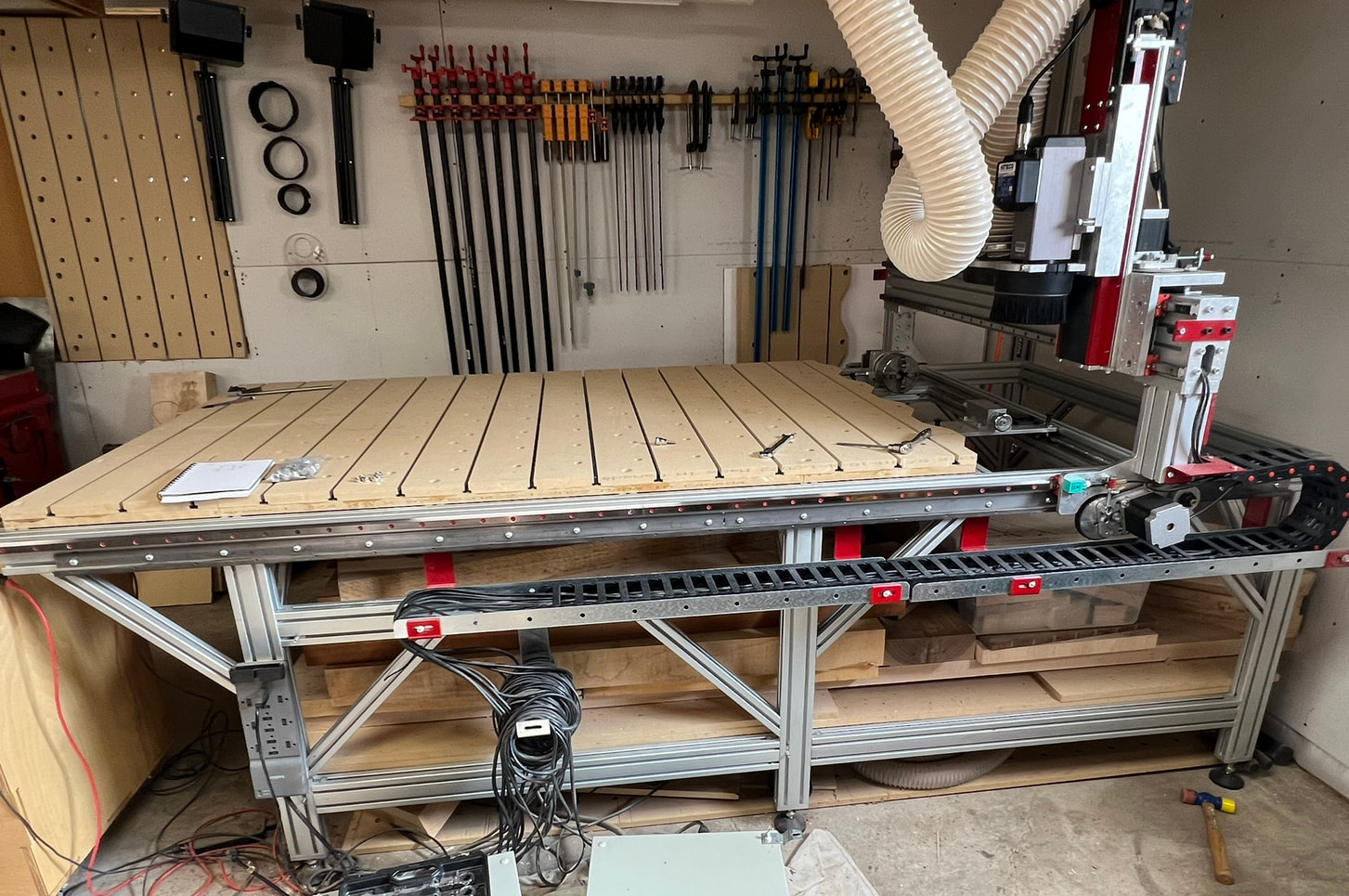
I have one that I used for the same thing. I would definitely go ahead and get a 10-12ft machine instead of the 8ft. If you add atc later on you will either need to buy a frame extension or add the retractable tool rack……I would prefer the extra bed size if you can fit it in your shop. I also ordered a mine with 1 peice side rails to help with stiffnes.
+1 - I normally do 4x8 sheets but got the 5x10 machine and don’t regret it. I’ve got room for the tool rack, rotary axis, clamps around the edge of the plywood (I put a 4x8 bed on it) and pockets around the edges for random vertical jigs or other weird needs.
Note: it’s fairly easy to make a machine longer. It’s very hard to make a machine wider.


 We’re talking .010” inlay bits.